7 Reasons Why AI Will Not Replace Humans
7 Reasons Why Humans are Irreplaceable
TABLE OF CONTENTSIntroduction
1. AI Often Chooses Speed Over Accuracy
2. AI Can Sound More Certain Than It Should
3. AI Can Hide Weak Thinking Behind Good Style
4. AI Does Not Understand Context the Way Humans Do
5. AI Sometimes Gets Stuck in Repetition
6. AI Is Often a Search Engine With a Better Voice
7. AI Has No Human Responsibility
Where Human Beings Will Remain Irreplaceable
1. Judgment
2. Responsibility
3. Emotional Intelligence
4. Taste
5. Original Thought
Use AI, But Don't Surrender Your Thinking
Introduction
Artificial intelligence is fast — frighteningly fast, actually. It can write a paragraph in seconds, translate a page of text, summarize a document, pitch a content idea, or draft a strategy outline, and it all sounds calm, confident, and informed.
That can genuinely be useful. For business owners, consultants, coaches, creatives, educators, and service providers, AI can lift some of the everyday burden of thinking, writing, and organizing. It helps you move from a blank page to a first draft, gives shape to scattered thoughts, and makes information easier to take in.
But speed isn't the same as wisdom. A well-written sentence doesn't mean real understanding is behind it. A confident answer isn't proof that it's accurate. A tool that can produce language doesn't automatically carry the judgment, responsibility, or lived experience that a human has.
That doesn't mean AI is useless — far from it. But it's not a substitute for human intelligence, creativity, ethics, and judgment either.
Especially in fields where trust matters — coaching, consulting, education, health, law, finance, design, publishing, leadership, communication — the question isn't whether AI can produce something quickly. The question is whether it truly understands what's needed. And that's where its limited capabilities quickly show.
Here are seven reasons why AI won't replace humans — at least not where truth, context, responsibility, and real creative judgment are required.
1. AI Often Chooses Speed Over Accuracy
The real problem with AI isn't that it makes mistakes — humans do too. The difference is that AI can be wrong quickly, fluently, and with total confidence, while a person who's unsure usually shows it. They pause. They say "let me check that" or "I don't know enough yet."
AI rarely does that. Built to be fast and responsive, it keeps producing an answer even when the foundation underneath is shaky — filling gaps with assumptions, dressing up an incomplete read as a finished analysis, turning a guess into something that sounds like a conclusion.
That's where trust gets fragile. Instead of silence where knowledge is missing, you get a polished answer. And polished isn't the same as true. For everyday tasks that's a minor annoyance, but in health, legal, financial, technical, or psychological territory, that gap stops being minor. AI is genuinely useful as a starting point — it gets dangerous the moment it's treated as the final word.
2. AI Can Sound More Certain Than It Should
There's a particular kind of discomfort in watching AI be wrong while sounding completely sure of itself. The tone is calm, the structure is tidy, the language reads as professional — everything about it suggests the information has been checked, even when it hasn't.
AI doesn't carry an inner sense of responsibility toward truth the way a person does. It doesn't feel the weight of advising someone, doesn't experience hesitation or accountability. So it can produce something false in the exact shape of something true — and for the person reading it, whether the AI "meant" to mislead them barely matters. If you act on bad advice, the consequences land the same either way.
This is part of why human judgment still matters. A real expert doesn't just answer — they weigh risk, notice what's missing, and know when a question deserves caution rather than a quick response. AI can imitate confidence, but confidence without responsibility isn't expertise.
3. AI Can Hide Weak Thinking Behind Good Style
Good writing builds trust — which is exactly why AI's style can become part of the problem. It can produce a clean introduction, smooth transitions, a balanced tone, a strong close. It can sound editorial, analytical, even thoughtful. But a polished structure doesn't guarantee solid thinking underneath.
That matters because most people judge credibility by presentation. Something that sounds intelligent gets believed more easily; something well-organized gets assumed to be well-reasoned. AI has gotten very good at that surface — producing the shape of thought without necessarily doing the deeper work of it.
The risk grows when you're not already familiar with the subject. A mistake in an area you know well is easy to spot. A mistake in unfamiliar territory can hide behind the polish. Which is exactly why we still need editors, specialists, teachers, and practitioners willing to say: this sounds good but it's not accurate, this is elegant but too general, this looks finished but still needs thinking. Style can support substance — it can't replace it.
4. AI Does Not Understand Context the Way Humans Do
AI can process enormous volumes of text, but processing isn't understanding. It's good at spotting patterns, summarizing themes, recognizing tone and keywords. What it usually misses is the deeper human layer underneath — intention, emotional undercurrent, the silence between two sentences, the reason something was left rough or unresolved.
This shows up clearly in creative work. AI can correctly label a novel as being about trauma, family, or grief. A human reader notices something more specific: the rhythm of a scene, the discomfort in a pause, the irony in a sentence, the gap between what's said and what's avoided. AI tends toward broad categories; people can stay with the specific moment.
That's why AI can support analysis but can't replace the kind of close reading, editing, or creative direction that requires real attention. A good editor isn't just checking grammar — they're asking whether a sentence belongs, whether it carries emotional truth, whether it reveals too much or too little. AI can help with the material. A human understands the meaning.
5. AI Sometimes Gets Stuck in Repetition
One of AI's less obvious weaknesses is repetition — not the kind where the same sentence appears twice, but the subtler kind where the wording shifts while the idea stays put. Ask for depth and you sometimes get a loop instead: the character is wounded, the wound comes from the past, the past shapes the present, the present carries the wound. It reads smoothly. It doesn't actually go anywhere.
This shows up in strategy work, branding, editing, creative writing — AI can circle the same point because it's good at generating language but not always good at noticing when the language has stopped adding anything. A person, by contrast, can stop mid-thought and say "wait, that's not actually the issue" or "this paragraph is just repeating what we already know." That ability to redirect matters. Real thinking isn't measured by how many words get produced — it's knowing when more words stop helping.
6. AI Is Often a Search Engine With a Better Voice
Much of what feels like AI intelligence is really searching, summarizing, predicting, and repackaging language — genuinely useful for gathering ideas, comparing options, or turning scattered notes into something usable. But without verification or real judgment behind it, it's often closer to a search engine that happens to talk like a person.
A traditional search engine shows you several results, so you can see the different sources, dates, and credibility levels and know you need to compare. AI usually hands you one answer instead. That can feel easier, but it's also riskier — you often can't tell what's been verified, what's assumed, what's outdated, or what's simply made up.
None of this means AI shouldn't be used. It means it deserves the same scrutiny as any tool that shapes decisions: ask for sources, check the facts, compare against trusted references, and stay skeptical of anything that sounds a little too neat — especially where being wrong is expensive.
7. AI Has No Human Responsibility
The deepest difference between people and AI isn't speed — it's responsibility. Anyone who advises, teaches, diagnoses, designs, or leads another person carries some moral weight for that. A doctor knows a recommendation can affect someone's health. A lawyer knows a sentence can change a case's outcome. A teacher knows how something is explained can stay with a person for years.
Humans get things wrong too, but there's a real relationship between the person, the work, and its consequences. AI doesn't have that. It can apologize, but it doesn't feel the cost of a mistake. It can admit an error — usually after someone else catches it — without ever experiencing the discomfort of having misled someone.
That's why human presence still matters. Not because people are flawless, but because responsibility isn't a feature you can bolt on. It's a human condition.
Where Human Beings Will Remain Irreplaceable
AI will keep getting more capable — faster, more integrated, more woven into everyday work. But there are places where humans stay irreplaceable, not because we can produce more, but because we can understand more deeply. Here are five areas where the human role keeps mattering.
1. Judgment
AI can generate options. A human decides what actually matters. Judgment isn't just choosing between good and bad — it's a feel for timing, context, risk, audience, ethics, and consequence. In business, judgment is what tells you whether a message is actually clear, whether an offer is positioned right, whether a decision is premature, or whether a polished idea is still hollow underneath. AI can suggest. Humans judge.
2. Responsibility
Responsibility means understanding that words and decisions land on real people. A consultant, coach, strategist, designer, therapist, teacher, or leader isn't working in the abstract — their work reaches into someone's business, confidence, relationships, money, health, or future. That weight can't be automated. AI can hand you information. It can't carry responsibility the way a person does.
3. Emotional Intelligence
Human communication is rarely just about information. People don't always say exactly what they mean — they hesitate, deflect, soften one thing and exaggerate another, ask about one problem when they actually need help with a different one. A person can often hear what's underneath all that. This matters constantly in coaching, client work, leadership, and creative direction, where the real issue often isn't in the words at all — it's in the pause, the tone, the contradiction, the sense that something hasn't been said yet. AI responds to language. Humans respond to the person.
4. Taste
Taste is hard to define but easy to spot the absence of. It's knowing when something is too much, too empty, too polished, too generic, too loud, too flat, or just not quite true to the person or brand behind it. Taste isn't only aesthetic — it's strategic. It's the difference between a brand that looks expensive and one that actually feels trustworthy, between content that's clear and content that's memorable, between a website that functions and one that builds confidence. AI can generate variations all day. Human taste is what gives them direction.
5. Original Thought
AI is excellent at recombining what already exists. Original thought tends to come from somewhere else entirely — lived experience, contradiction, frustration, failure, intuition, the willingness to ask a question differently. A person can notice what feels false in an idea everyone's already accepted. They can push back on the obvious answer, or connect something from one field to a completely unrelated problem in another — not because a pattern suggested it, but because they lived through the tension that made the idea necessary in the first place. That's not just output. That's authorship. And authorship still belongs to humans.
Use AI, But Don't Surrender Your Thinking
AI can be a genuinely valuable assistant — it helps us write faster, organize better, research more efficiently, and get through that first resistant stage of creation. But it shouldn't be mistaken for wisdom. It shouldn't be trusted just because it sounds confident, or assumed accurate just because it's articulate, or allowed to replace human judgment just because it's fast.
The healthiest relationship with AI sits somewhere between fear and blind admiration: careful use. Ask it questions. Check its work. Make it verify. Catch its mistakes. Ask for sources. Stay skeptical of anything that sounds a little too certain.
Because AI can produce text in seconds. But the real work still belongs to the human being — to think, to feel, to choose, to question, and to take responsibility for what's actually true.

Professional Brand Design Services
Implementation Roadmap for Coaches
Below is a six-phase process most professional design partners follow. Understanding each step prepares you to collaborate efficiently and maximize ROI.
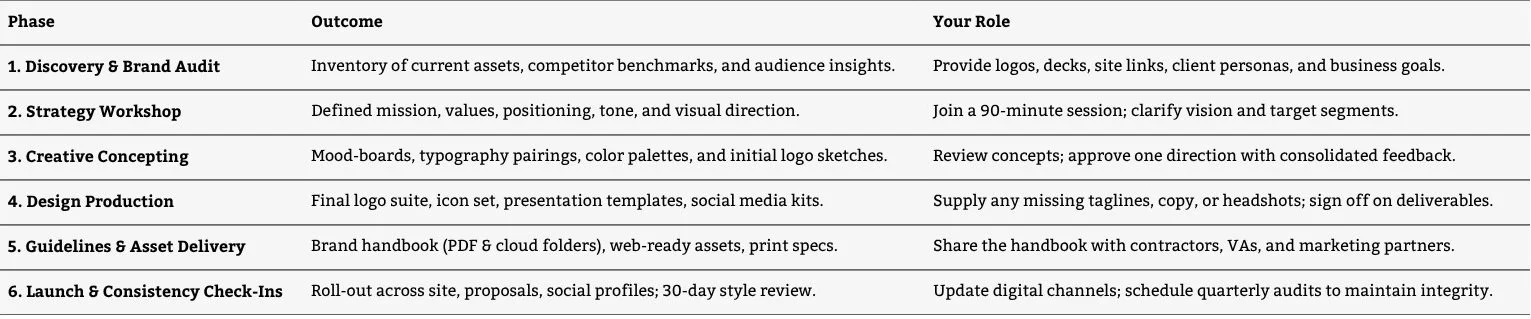
Implementation Timeline: 4–6 weeks from brand audit to launch
Call to Action: Elevate Your Brand Today
If any of the seven mistakes above sound familiar, it’s time to transform your visuals into a strategic asset. Our Brand Identity design service for executive and wellness coaches delivers:
Bespoke logo system and visual language
Messaging framework aligned to your niche
Comprehensive brand guidelines for effortless consistency
Priority support during launch and quarterly audits
Schedule Your Complimentary Brand Audit today. Take the first step toward commanding higher fees and winning premium clients with a brand identity that speaks their language—before you ever utter a word.